

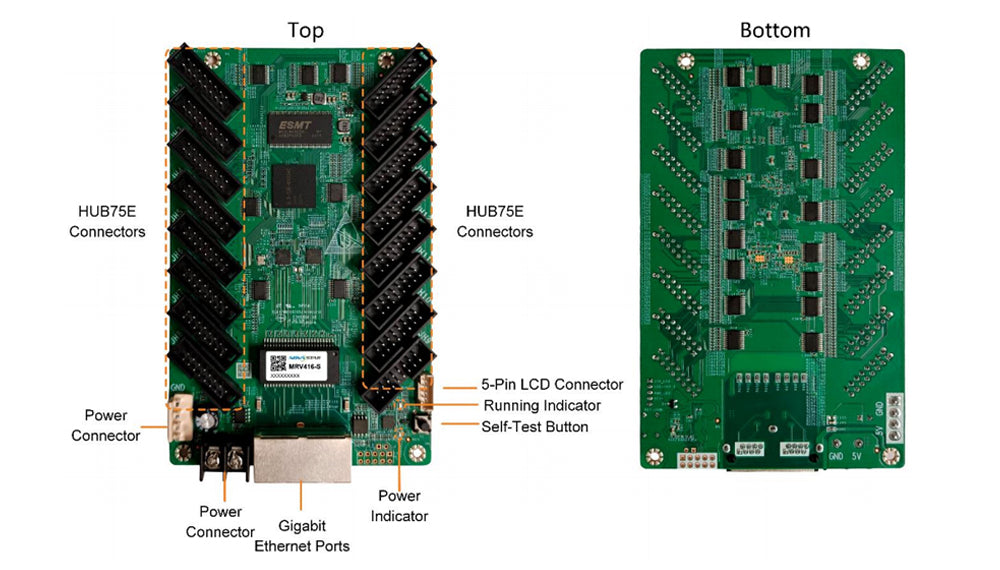
Description
The Novastar MRV416-S is an LED display receiving card with 16 standard HUB75E connectors and support for up to 32 groups of parallel RGB data. It connects to the sending card through Gigabit Ethernet and distributes display data to the LED modules. Each Ethernet connector can be used as an input or output for cascading receiving cards.
For an 8-bit video source at 60 Hz, one card supports up to 512 × 512 pixels with PWM driver ICs or 512 × 384 pixels with common driver ICs. Match the load to the module’s driver IC; the larger figure does not apply to every configuration.
MRV416-S Technical Specifications
| Parameter | Specification |
|---|---|
| Brand / model | NovaStar / MRV416-S |
| Module connectors | 16 standard HUB75E connectors |
| Parallel RGB data | Up to 32 groups |
| Maximum load — PWM driver IC | 512 × 512 pixels at 60 Hz with an 8-bit video source |
| Maximum load — common driver IC | 512 × 384 pixels at 60 Hz with an 8-bit video source |
| Input voltage | DC 3.8–5.5 V |
| Rated current | 0.45 A at 4.2 V |
| Rated power consumption | 1.89 W |
| Operating temperature | −20°C to +70°C |
| Operating humidity | 10%–90% RH, non-condensing |
| Storage temperature | −40°C to +85°C |
| Storage humidity | 0%–95% RH, non-condensing |
| Dimensions | 91.5 × 144.0 × 19.3 mm |
| Net weight | 106.8 g per receiving card |
Actual power consumption varies with settings, usage and environmental conditions. See the specification PDF below for connector definitions and mechanical drawings.
Display Quality and Image Adjustment
- Color management and 18bit+: support for standard and custom color gamuts, plus improved grayscale performance at low brightness.
- Pixel-level brightness and chroma calibration: works with NovaStar’s calibration system to improve consistency across pixels. Calibration coefficients can be uploaded, read back, saved to hardware and erased.
- Seam and batch correction: quick adjustment of dark or bright lines and multi-batch adjustment help align brightness and chroma between modules or cabinets.
- Individual RGB gamma: separate red, green and blue gamma adjustment with NovaLCT and a controller supporting this function.
- Low latency: receiving-card latency can be reduced to one frame when using modules with driver ICs that have built-in RAM.
- 3D and rotation: 3D output requires a controller supporting 3D. The card supports 90° image rotation; free-angle rotation requires the dedicated MCTRL R5 controller and SmartLCT software.